.png)



Summary
A leading Non-Banking Financial Company (NBFC) was struggling with high costs and operational inefficiencies due to managing multiple isolated Loan Management Systems (LMS) across different lending sectors, including microfinance, corporate finance, and supply chain. AceNet Consulting deployed a specialized team to conduct comprehensive stakeholder workshops, workflow analysis, and system evaluations. The project delivered consolidated business requirement documents (BRDs), a unified feature list, and a high-level technical architecture, successfully laying the strategic groundwork for a single, cost-efficient enterprise LMS.
Challenge
The NBFC was burdened by the high costs and operational friction of maintaining multiple, disconnected legacy Loan Management Systems. Because different systems were used to support different lending sectors (such as microfinance, corporate finance, and supply chain), the organization lacked a unified view of its data and processes.
Objective
Streamline operations and drive cost efficiency by defining the requirements and architectural blueprint to consolidate all existing LMS platforms into a single, unified Loan Management System capable of supporting all lending sectors.
Solution
Deploy a cross-functional expert team consisting of an Architect, Subject Matter Expert (SME), Business/Data Analyst, and Project Manager. Map existing workflows, identify ground-level operational bottlenecks, and design a comprehensive high-level technical architecture and consolidated requirements package for the new unified LMS.
Execution
- Hosted deep-dive discovery workshops with the client to understand all existing loan products and systems across the various lending sectors.
- Documented current business workflows and the exact capabilities of the disparate legacy LMS systems.
- Conducted extensive stakeholder interviews across multiple divisions - including business, operations, finance, and application support - to capture ground-level challenges and compile a "wish list" for the unified system.
- Extracted and documented all reporting and compliance requirements from the existing LMS platforms to ensure parity and regulatory safety in the new system.
Results
- Successfully prepared consolidated business artifacts, including a comprehensive Business Requirement Document (BRD) and a unified feature list catering to all lending products.
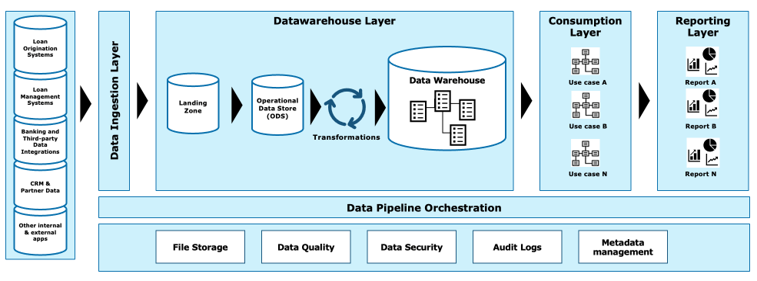
- Delivered a high-level technical architecture specifically designed for the consolidated LMS platform.
- (Note: Specific implementation or post-launch production metrics were not provided in the project scope).
Tech Stack
- Business Requirements Gathering
- Process Mapping & System Evaluation
- Stakeholder Workshops & Interviews
- Gap Analysis & Feature Consolidation
- Documentation of Reporting & Compliance Needs
- High-Level Technical Architecture Design
Key Takeaways
- Consolidation Drives Efficiency: Operating multiple sector-specific systems creates unnecessary technical debt; establishing a unified architecture blueprint is the first step to reducing IT maintenance costs and operational friction.
- Cross-Functional Alignment is Critical: Interviewing stakeholders across business, finance, operations, and IT support ensures the proposed architecture addresses real ground-level pain points rather than just high-level technical specifications.
- Thorough Discovery Mitigates Risk: Meticulously documenting existing workflows, capabilities, and strict compliance requirements before writing any code ensures the resulting architecture actually covers all legacy use cases and regulatory obligations.
Business/Solution Architecture | Deliverable